Distinguish social and economic realities that underlie the development of professional sports in Papua New Guinea

Let me start by saying anything that brings close to 800 different tribes in our country together as a united nation is a good thing. Because of our diverse cultures, anything that causes us to find common ground is an important agent for national unity, a prerequisite for proper and harmonious nation building.
For a lot of nations, it took terrible and forceful human tragedy that required people to stand up in unison to fight a common enemy to foster the sense of nationalism and pride. It took adversity to define their nation’s character. But in the absence of a major calamity, sport has emerged over the years as an important agent that can foster similar national pride and camaraderie.
It is no wonder that stories about sporting rivalries are often written using militaristic vocabulary. Hence, sport has become the modern day substitute of physical warfare and adversity to bring people together for a common goal.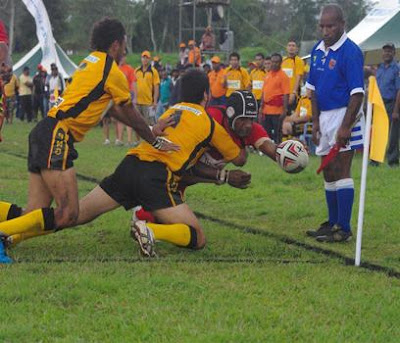 From this perspective, it is not hard to see why every Papua New Guinean from all four corners of our country shares the one common passion when our national teams go into battle with other teams from other countries.
Rugby league appears to be the most supported sporting code as demonstrated by the raw passion we have for our national team, the Kumuls. I know I shouted my lungs dry for our team when they played in the Rugby League World Cup last year, and so were everyone on my street at Waigani, Port Moresby and indeed throughout the nation.

It has become big business and, therefore, like every other business, the important precondition of a willing and able market must exist to sustain it. Without such a market, its imminent demise in the not too distant future is as sure as the going down of the rays. I know a lot of people will come out swinging when they read this, but I am happy to play devil’s advocate for the sake of providing balance in the thinking behind introducing professional sport in our country at this juncture.

Our sporting market in PNG simply does not possess the economic characteristics required to support professional sports, whether it be Rugby League, Soccer, Netball, Cricket or any one of the other codes. There are very few people in Port Moresby and PNG who can afford to constantly squeeze entertainment spending, including for sport, out of their disposable income over an extended period of time. For starters, we have not adequately developed our middle class, who are the backbone of any economy, to ask them to support professional sport in a practical way.
 So in the absence of an appropriately affluent market to support it, professional sport in PNG, especially our NRL team, will continue to look elsewhere for its sustenance once it has been established. Two other sources of funding spring to mind: big businesses and the government.
I can not speak for big businesses because they will obviously be guided by commercial disciplines when committing their financial resources towards this course.
 Their support to professional sport will be an investment only to the extent that they can demonstrably recoup it with an appropriate margin from the market in a sustained manner. This clearly can not happen in the PNG market under our current economic circumstances. Those who think we can get big businesses in the extractive industry, or other businesses and individuals who rely on them, to support professional sport in our country are living in a fool’s paradise.
It is like walking merrily down to the gallows with full knowledge of your looming execution.
With support from the market and big businesses looking increasingly shaky, where does that leave us with the government? With all due respect to the government’s intentions and support of our NRL bid, I think this is an ill conceived move because it is sure to put significant pressure on the government’s limited finances going forward.
The combative nature of sports is the one major striking similarity it has to a physical warfare. It is the element that promotes feelings of oneness and the pursuit of a common goal of victory.
It is no wonder that stories about sporting rivalries are often written using militaristic vocabulary. Hence, sport has become the modern day substitute of physical warfare and adversity to bring people together for a common goal.
From this perspective, it is not hard to see why every Papua New Guinean from all four corners of our country shares the one common passion when our national teams go into battle with other teams from other countries.Rugby league appears to be the most supported sporting code as demonstrated by the raw passion we have for our national team, the Kumuls. I know I shouted my lungs dry for our team when they played in the Rugby League World Cup last year, and so were everyone on my street at Waigani, Port Moresby and indeed throughout the nation.
In the first game when we almost beat England, I was beaming with pride and tears freely rolled down my cheeks by default. I never forced the tears. They just came from nowhere. It was truly a rare feeling of adrenalin rush. I felt the same when Ryan Pini and Dika Toua competed at the Commonwealth Games and when Stanley Nandex head hunted his opponents with those powerful kicks.
Recognising the important uniting aspect of sports and Rugby League in particular, our government has committed to building a modern stadium in Port Moresby and has put together a team to bid for the right to enter a PNG team in Australia’s National Rugby League competition. Such a move appears to make sense from a social perspective. But how does it sit in the overall scheme of things in respect of where our national priorities lie.
We are now talking professional sport and there is much more to it than simply building a nice modern sporting stadium and entering a team in the NRL. Sport has evolved over the years to become an industry in its own right where its traditional entertainment value has been monetised.
It has become big business and, therefore, like every other business, the important precondition of a willing and able market must exist to sustain it. Without such a market, its imminent demise in the not too distant future is as sure as the going down of the rays. I know a lot of people will come out swinging when they read this, but I am happy to play devil’s advocate for the sake of providing balance in the thinking behind introducing professional sport in our country at this juncture.
Even when I was completely overwhelmed by the emotions of seeing the Kumuls compete bravely to the end, I still refuse to listen to my heart when it comes to making decisions that require me to use my brains. This is because although we do have a very willing local market for the product, that market is largely handicapped financially.
Our sporting market in PNG simply does not possess the economic characteristics required to support professional sports, whether it be Rugby League, Soccer, Netball, Cricket or any one of the other codes. There are very few people in Port Moresby and PNG who can afford to constantly squeeze entertainment spending, including for sport, out of their disposable income over an extended period of time. For starters, we have not adequately developed our middle class, who are the backbone of any economy, to ask them to support professional sport in a practical way.
So in the absence of an appropriately affluent market to support it, professional sport in PNG, especially our NRL team, will continue to look elsewhere for its sustenance once it has been established. Two other sources of funding spring to mind: big businesses and the government.I can not speak for big businesses because they will obviously be guided by commercial disciplines when committing their financial resources towards this course.
But I would like to observe that the market must still absorb their costs and they will surely feel the heat at some stage when this fails. Businesses are responsible to their shareholders first and foremost and must earn an appropriate level of profits before engaging in activities such as sponsoring professional sport.
Their support to professional sport will be an investment only to the extent that they can demonstrably recoup it with an appropriate margin from the market in a sustained manner. This clearly can not happen in the PNG market under our current economic circumstances. Those who think we can get big businesses in the extractive industry, or other businesses and individuals who rely on them, to support professional sport in our country are living in a fool’s paradise.It is like walking merrily down to the gallows with full knowledge of your looming execution.
With support from the market and big businesses looking increasingly shaky, where does that leave us with the government? With all due respect to the government’s intentions and support of our NRL bid, I think this is an ill conceived move because it is sure to put significant pressure on the government’s limited finances going forward.
The market can not support this mammoth economic liability we are about to create. So the government will have to bear most of the financial burden at the expense of other key priority development expenditures such as health care, human resource development and infrastructure. In fact the government is already struggling to fund these important areas without unnecessary commitments such as this.
 I dare say the talk about fielding a PNG Rugby League team in the NRL is hardly a visionary decision and will only result in distorting government’s spending priorities in the long term.
This idea must be ditched and sports must be developed in a more sustainable way so as to not shift the government’s focus away from its key priority areas. As a nation, we surely can do without sport but not without proper health care, an appropriate investment in human capital development and a continuous focus on building and maintaining our key infrastructure network.
I challenge the government to do everything within its powers to empower the great majority of our people who are crying out for basic services, instead of introducing things that have a real potential to distort its priorities in future. We, the people, will rise up over time and build a more sustainable professional sporting industry in PNG when our socio-economic situation improves. Now is not the time!
Labels: Sports
posted by whponline @ 7:59 PM
0 Comments


 Perhaps, the new sports minister would want to concentrate on committing more funds to rugby league in the country and junior development at all schools throughout the country. At the same time, convert Port Moresby Rugby League (PRL) grounds to a stadium for international matches because PRL doesn't look ideal for big tournaments against big rugby league nations like Australia, New Zealand, Great Britain, and others.


